
Top students awarded at first symposium
Building a wall against the Mississippi River seemed like a good idea in 1722, but
300 years of levees holding back the water have wreaked havoc on Louisiana's ecology,
said 91制片厂 student Kristin Barnes at 91制片厂鈥檚 first academic symposium.
In her winning presentation in the science, technology, engineering and math (STEM)
division, Barnes discussed the concerns and possible solutions to the increasingly
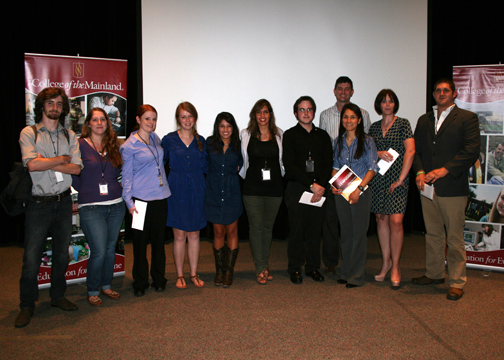
pressing issue. She and six others earned scholarships their work on topics affecting
the region and its residents today.
Also receiving first place awards were Lee College student Austin Eldridge in the
social and behavioral sciences division, 91制片厂 student Lizz Dobson in the fine arts
division and 91制片厂 student Matthew Suggs in the communication and humanities division.
In the STEM poster category, Trey Gammon, Zach Martin and Abby Ficklin from Lee College
won first place for "Living Shorelines: Small-Scale Restoration Efforts and Their
Ecological Impacts on Local Communities,鈥� which analyzed data regarding small-scale
habitat restoration projects.
鈥淚t was an opportunity to see a love of learning in action,鈥� Dr. Vicki Stanfield,
Vice President of Student Services. 鈥淲e鈥檙e glad to be giving our students a better
understanding that every word they speak has influence.鈥�
Students came from Lee College, Alvin Community College, 91制片厂 and Clear Falls High
School to discuss a variety of topics鈥攆rom the Pleasure Pier to Texas City Disaster鈥攁t
the event sponsored by the Gulf Coast Consortium of Community Colleges.
鈥淲e wanted the students to experience all important steps in academic discourse, from
submission to presentation of their work,鈥� said professor Veronica Sanchez, co-organizer
of the event with professor Dalel Serda.
A lover of history, Barnes became interested in science in Sanchez鈥� class and worked
to integrate the two in her presentation on how the Louisiana levees affected the
region鈥檚 ecology.
鈥淗istory is just gossip, who doesn't love gossip? It was compelling to learn how the
actions of the people counteracted the natural mechanisms to create such a disaster
for the Louisiana coast,鈥� she said.
Other students explored historical conflict in the region. In his winning presentation,
鈥淕alveston Bay: 1979 to 1981鈥擱acial Terrorism in a Small Texas Town,鈥� Eldridge explored
the antagonism that Vietnamese fisherman faced from the Ku Klux Klan. Eldridge became
interested in the subject after honors professor John Britt mentioned it in class.
鈥淚鈥檝e lived in Kemah and League City all my life. When I found out about something
that happened in my backyard, I thought, 鈥業 should research this,鈥欌�� Eldridge remembered.
The fishermen went to court and won a federal injunction against the group. The story
inspired him.
鈥淰ietnamese refugees鈥onded together as a community and with strong work ethic. Despite
the efforts of the Ku Klux Klan, the Vietnamese overcame racial prejudice and established
a strong presence in the Texas Gulf Coast fishing industry,鈥� he concluded.
Fine arts division winner Lizz Dobson collaborated with other artists to create a
compilation of images documenting post-Ike Galveston. A native of Australia, Dobson
came to the U.S. after Hurricane Ike to volunteer with Youth at Risk and eventually
settled in Kemah. After examining the evocative images, she titled her work 鈥淪ustained
Through Time.鈥�
鈥淭he devastation wrought by Hurricane Ike still echoes in the memories of Gulf Coast
residents,鈥� said Dobson in her artist description.
Other students crunched the numbers on topics that affect society. Suggs analyzed
data from seven school districts to show how students鈥� various options affected the
admissions benefits they received at universities in his presentation 鈥淗igh School
College Credit Opportunities: The Foundation of Post-Secondary Academic Inequality.鈥�
鈥淚t鈥檚 a topic that impacts us all. There鈥檚 so many options, especially here (in the
Gulf Coast),鈥� he said.
The symposium offered all students and participants the chance to discuss their presentations
formally in question-and-answer sessions and informally during lunch and coffee breaks.
鈥淲hat we wanted was a very academic dialogue, that camaraderie you strive for in an
academic environment. I think we achieved that,鈥� said Sanchez.
Sanchez and Serda are already looking ahead to next year鈥檚 topic: 鈥淐ontroversy in
Our Nation: Past, Present and Future.鈥�